Some product ideas have to wait for the technology to catch up.
Strategy Connect began as software supporting the way Aidan Nuttall worked with organisations on strategy.
Over the years we kept talking about things we wished the software could do. Eventually the technology changed enough that some conversations stopped being hypothetical.
I met Aidan because I made up a startup idea on the way to the stage.
At an early startup event, I volunteered to pitch. On the way up, I settled on an idea: using the emerging iPad and touch interfaces to help children learn.
Aidan was in the audience and joined the team. We spent the weekend making a rough prototype, working through a business canvas and getting out of the building to talk to real people. Would anyone actually pay for it?
The lasting result wasn't the startup idea. It was meeting Aidan.
Then Aidan showed me the product he was building.
Strategy Connect was an early SaaS product supporting his work with organisations. When I reviewed it, there were some foundational problems to address.
Changing an identifier could expose another account's information. Logging in and opening screens could take tens of seconds. Before adding more capability, we needed to improve security, performance and the everyday experience.
We secured the account boundaries, worked on performance and replaced the frontend while preserving the business logic. What began as a review grew into a much longer product relationship.
The software didn't create the strategy.
Aidan and his father, Kevin, helped organisations work through their own strategic thinking. Their role was to facilitate it, not arrive with someone else's answer.
- Foresight
- Insight
- Action
The platform gave that thinking somewhere to live and a way to follow its progress. Tracking a strategy is different from ticking off tasks.
Did we do the task?
Is the strategy progressing?
We kept imagining what the software could become.
Could it understand the strategy well enough to notice drift? Could it bring external threats and opportunities into the conversation? Could it find deeper insights and support the facilitator?
These conversations started before ChatGPT. The ideas were interesting, but building them would have meant specialist teams, substantial data work and a level of investment that didn't make sense for a small team.
The problem wasn't a shortage of ideas. It was finding a practical way to build them.
The ideas weren't new.
The technology finally caught up.
Meanwhile, Strategy Connect kept running.
I was the primary developer, and for much of the original development the only developer. Aidan brought the product ownership and domain knowledge. Together we kept evolving a working production system.
Aidan also built a substantial set of automated acceptance tests. They captured how the product was expected to behave.
Over time, we accumulated more than code: business logic, a shared understanding of the product and a way to check that it still worked. All three mattered when we came back to its foundations.
Then the economics changed.
The stack was ageing. A new foundation was appealing, but a conventional rebuild meant months of work, significant cost and the risk of losing behaviour that had accumulated over years.
I was still sceptical about AI-assisted development for serious work. Aidan suggested we try an experiment.
A rebuild I'd expected to take months happened in days.
That doesn't mean years of product development happened in days. The understanding already existed. AI shortened the path from that understanding to a new technical foundation.
The old tests made the new speed useful.
We could introduce the new interface against the existing backend, run the tests and verify the behaviour. Then we could replace the backend and check again.
- New UI + existing backend
- Test + verify
- New UI + new backend
- Test + verify
AI increased the speed of change. Existing engineering discipline made that speed usable.
AI didn't just make the old software faster to build.
The rebuild was about AI-assisted development. Engage+ was about AI as a product capability. They were different changes.
Doing the old thing faster was useful. Being able to do something that had previously been impractical was more interesting.
How do you have a meaningful conversation with 1,000 people?
Surveys scale, but the questions and answer formats constrain what people can say. Conversations give you depth, but a facilitator can't have them with everyone at once.
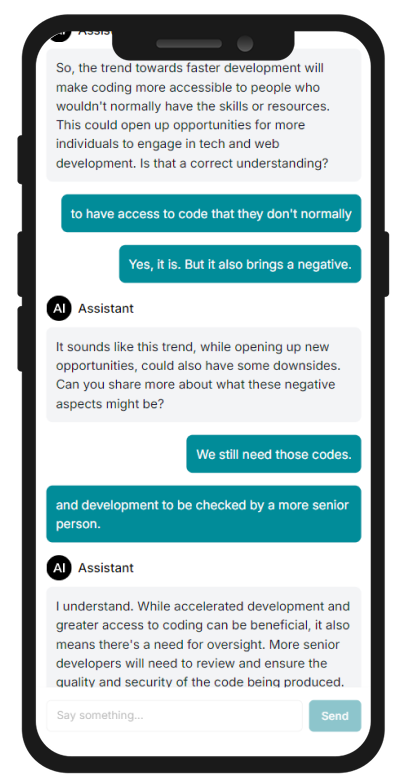
Engage+ explores that gap. A participant follows a link into a familiar conversational interface. The AI asks, listens, follows up and captures the response.
The conversation is the way in. Understanding what people are saying across all those conversations is the next problem.
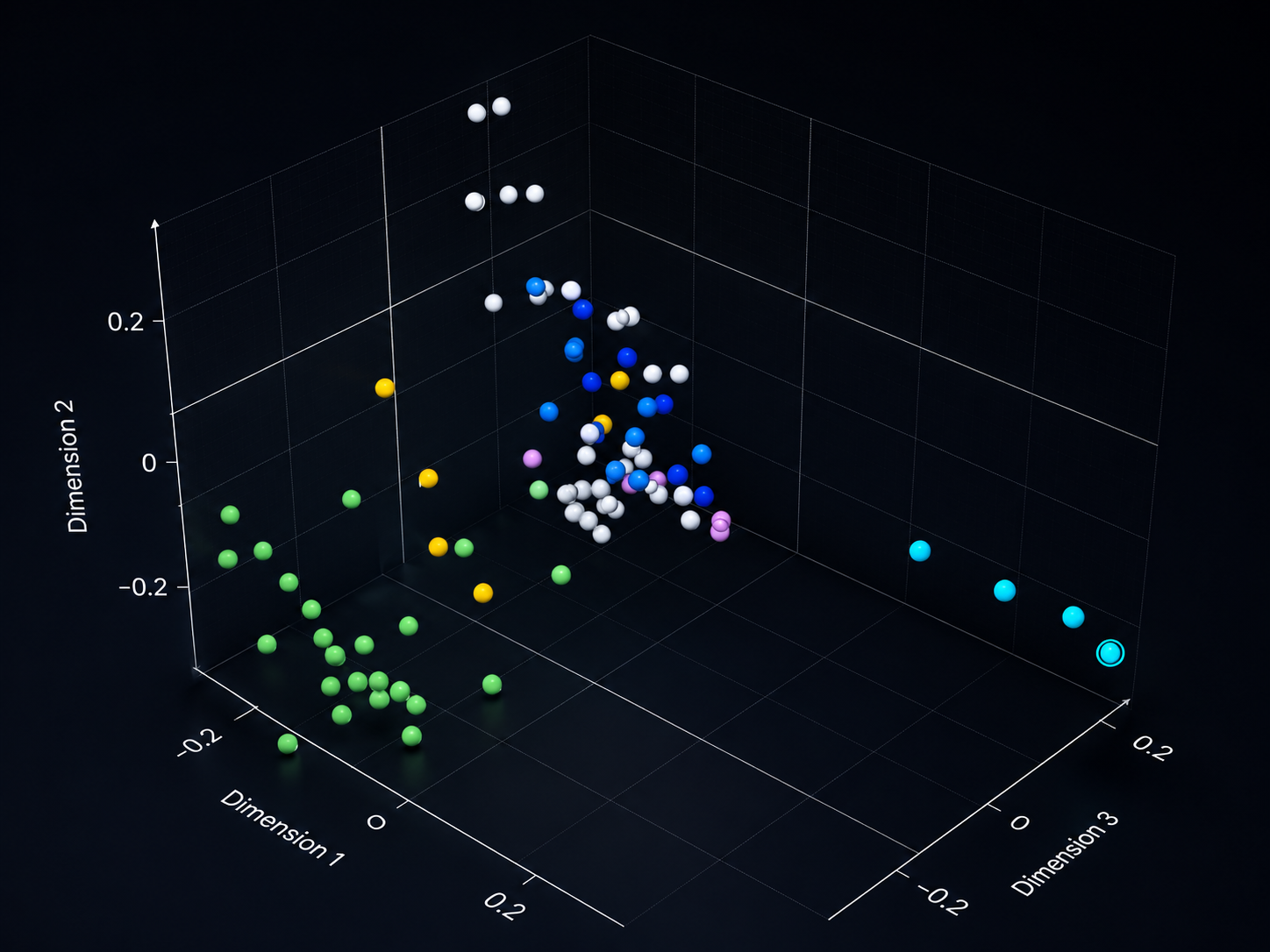
Thousands of answers only matter if you can understand them.
Responses can be represented as vectors, grouped into clusters and explored as common themes. The visualisation helps people see patterns across an organisation, then drill back into the responses behind them.
A cluster is a starting point for understanding, not a replacement for the people who contributed. Commonality is useful, but outlying views need to remain visible too.
Conversation changed the safety model.
During a real-world deployment, a serious safety-related response needed escalation. It made something very clear: conversational input changes what a product has to be ready for.
With a conventional form, we think about known fields, types and validation. With an open conversation, we also have to think about unexpected intent, sensitive content, abuse, off-topic responses and safety.
Guardrails, observation, moderation and escalation become part of the product. Real people don't stay inside the examples we used while building it.
Strategy used to hear from a few people. Now it can potentially hear from everyone.
Strategic conversations often begin with executives, leadership workshops and selected groups. Engage+ opens up the possibility of hearing from a much broader part of the organisation.
- Leadership perspective
- Organisation-wide conversations
- Strategic context
- Strategy
Aidan is increasingly looking at how Engage+ and Strategy Connect can come together. That's a product direction, not a claim that the integration is complete. The opportunity is to bring more of the organisation into the thinking behind its strategy.
Some conversations take years to become products.
This story is as much about a long relationship as it is about technology. We kept talking about things that weren't practical to build. Then some of them became practical.
Strategy Connect could be rebuilt because the economics changed. Engage+ became possible because the capabilities changed. Those are related, but they aren't the same thing.
The part that excites me isn't reproducing software we already know how to build. It's finally being able to explore the things we couldn't.
Sometimes the product idea has to wait for the technology.