Can AI take a food order without making the experience worse?
Ordering food sounds like a straightforward conversation.
Until you try to automate it.
People change their minds. Interrupt themselves. Ask questions about the menu. Add something halfway through. Remove something else.
A customer might say:
“Can I get a chicken burger meal?”
Then:
“Actually, make that large. And no ice in the drink.”
The system needs to understand the conversation, maintain the order and respond naturally.
And eventually it needs to turn that conversation into something the restaurant can actually fulfil.
I wanted to see how close we could get.
So I built Poszo.
Poszo is a conversational ordering prototype.
It uses AI to understand spoken requests, maintain an order and respond to changes during the conversation.
I connected it to a real Red Rooster menu so I could experiment with actual products and ordering behaviour rather than a handful of invented examples.
The early versions were too conversational in the wrong ways.
Too much introduction. Too much confirmation. Too much unnecessary enthusiasm.
I kept refining the experience.
A good ordering conversation should be quick. It should understand what you mean, ask when something is unclear and otherwise get out of the way.
The goal wasn’t to make an AI that could talk about food. It was to make ordering food easier.
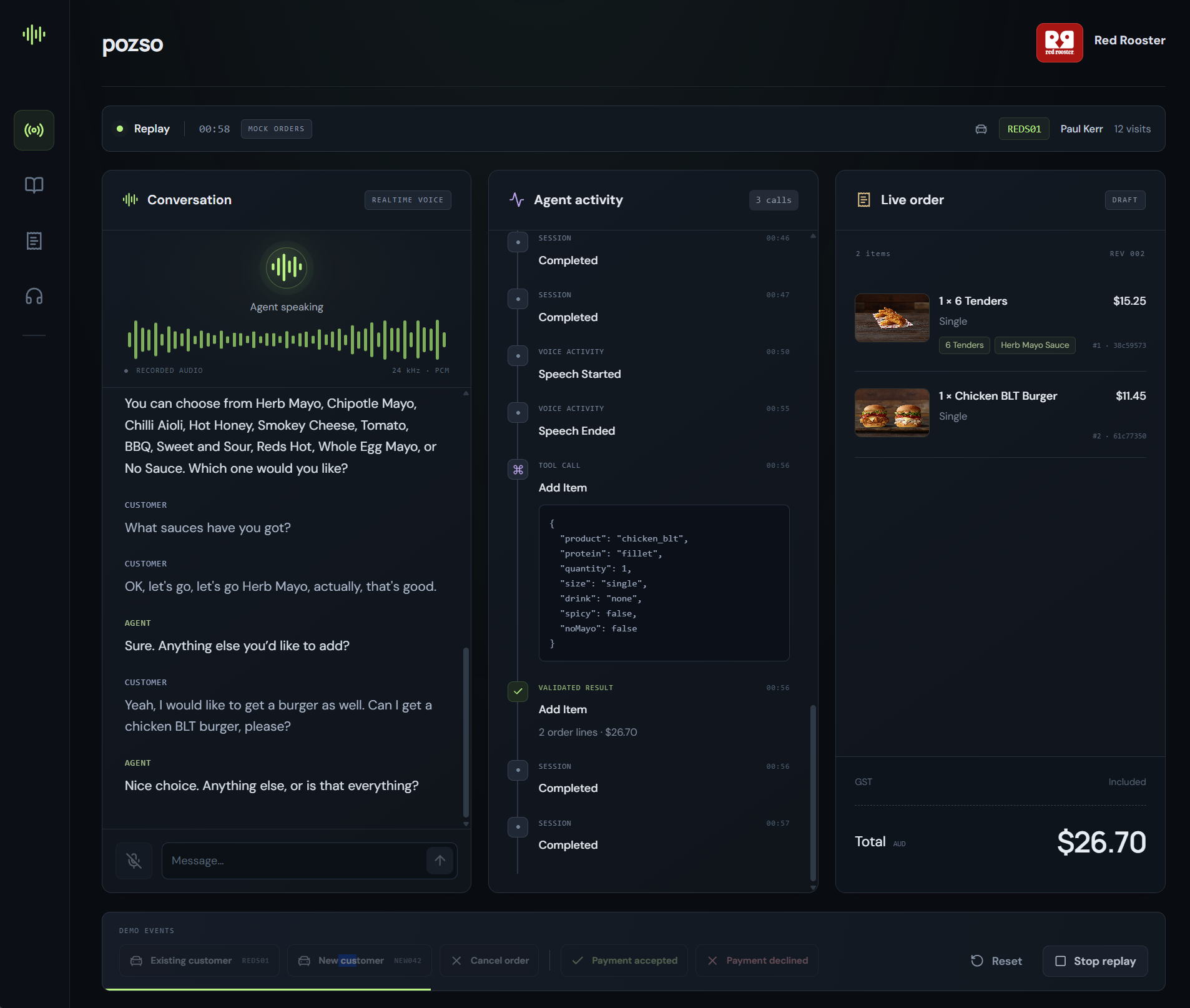
A real prototype test using menu items. The replay shows a mock order, not a completed restaurant transaction.
Then the experiment became a business conversation.
I shared the prototype with Craveable Brands, the group behind Red Rooster, Oporto and Chicken Treat.
There was interest in exploring the idea further, including how conversational ordering might make the customer experience faster.
That got me thinking about the journey customers make before they even reach the restaurant.
A drive-through is only one place where someone might want to order.
What if the conversation started earlier?
Why wait until you reach the drive-through?
Imagine you’re driving home.
You know what you want for dinner.
Instead of waiting until you arrive, you could start the order from your car.
“Get me a chicken burger meal from Red Rooster.”
The system could clarify the details, confirm the order and eventually connect it to an appropriate collection experience.
The important part is that the underlying conversational engine doesn’t necessarily care whether the customer is standing at a drive-through, using a phone or interacting through an in-car interface.
The interface changes.
The ordering capability can remain largely the same.
I thought I was building a drive-through ordering system.
I was actually exploring a different way to interact with commerce.
What would ordering from the car look like?
I started exploring an in-car interface for Poszo.
The idea is deliberately simple.
Voice handles the conversation.
The screen shows enough information to reassure the customer that the order is correct.
A short order summary. A total. Clear confirmation.
Not another complicated menu to navigate while driving.
This is a visual concept, not a working Apple CarPlay application. The platform capabilities, supported app categories, entitlements, interaction restrictions and driver-safety requirements still need to be validated.
The concept helps me explore the experience before committing to an implementation.
The interface doesn’t have to define the product.
This is the part I find interesting.
The same underlying ordering capability could potentially support different customer experiences.
At a drive-through, it might replace a conventional ordering conversation.
On a phone, it might offer a faster alternative to navigating a menu.
In a car, it might let someone begin an order before arriving.
Each environment introduces different constraints.
The conversation, interaction design, integrations and safety requirements would need to adapt.
But the underlying capability could be shared.
Working prototype
Conversational ordering engine
Menu · Order state · Conversation · Validation
Proposed experiences / Not deployed integrations
- 01 / Drive-through
At the restaurant
Voice ordering at the restaurant
- 02 / Mobile
On a phone
Conversational ordering on a phone
- 03 / In-car
Before arriving
Voice-first ordering concept
Sometimes the experiment isn’t the product.
I started by trying to answer a specific question about drive-through ordering.
Could AI handle the conversation?
Building Poszo helped me understand what worked, what felt awkward and what needed to change.
But it also revealed another possibility.
The conversational capability might be useful in places I hadn’t originally considered.
There’s still plenty to validate.
Whether customers would prefer it. Whether it genuinely saves time. How ordering, payment, collection and safety would work in different environments.
Those are product questions, not just AI questions.
And they’re worth exploring.
One experiment. Another question.
I started with a drive-through.
Now I’m wondering what happens when the same conversation moves into the car.
That’s usually how the next experiment begins.