Can AI take a drive-through order without making the experience worse?
Voice AI can hold a conversation. Taking a restaurant order is a harder test.
I'm building Poszo to explore whether realtime AI can understand a menu, handle interruptions and changes, construct a valid order and know when it should hand the conversation to a person.
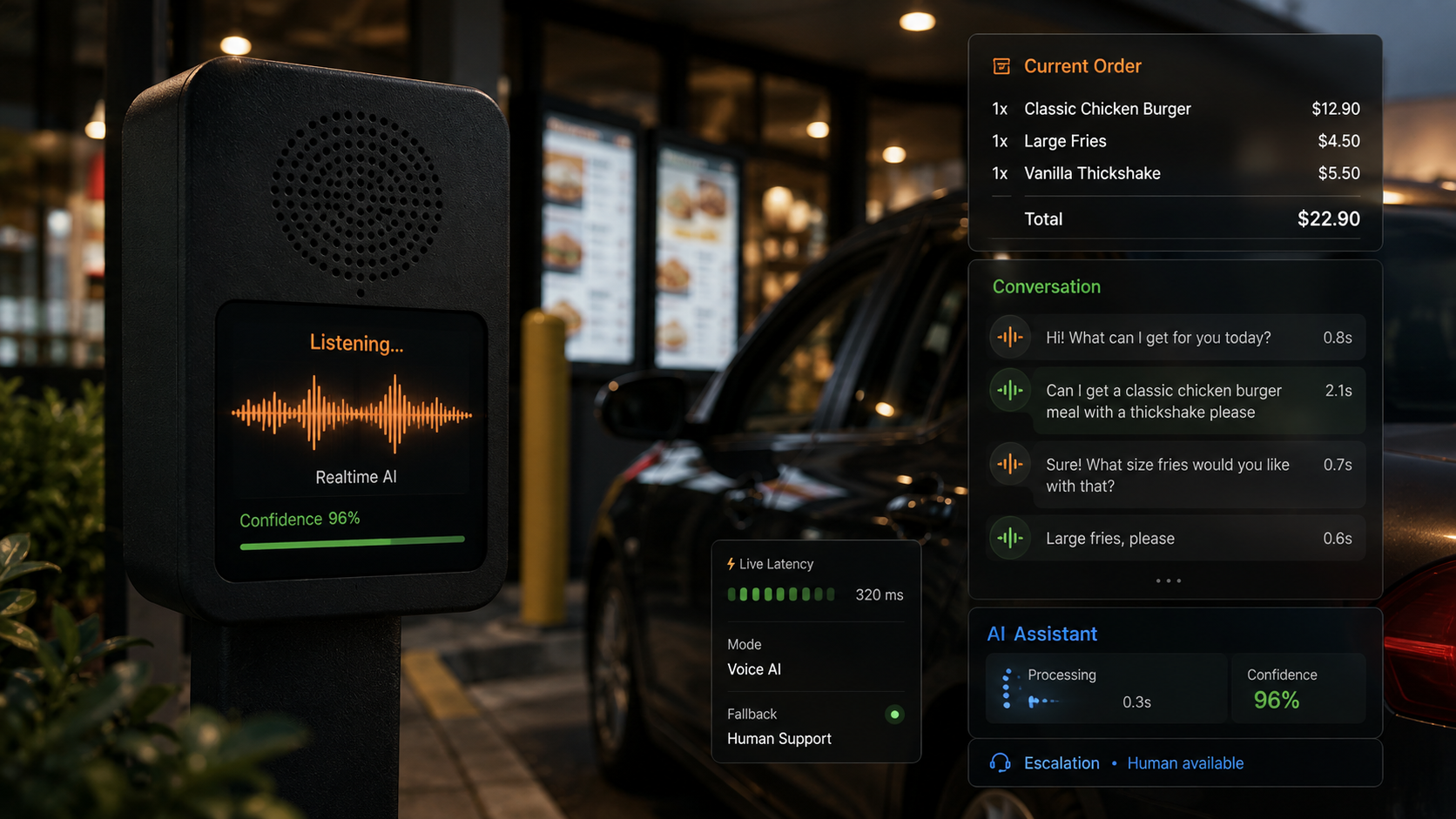
Exploring realtime conversation and restaurant ordering.
A conversation isn't an order.
- “Can I get a large chicken combo?”
- “Actually make that spicy.”
- “No drink.”
- “Wait — make it two.”
A useful ordering system has to do more than transcribe those sentences. It has to understand what changed, map the conversation to a real menu and maintain a valid order while the customer changes their mind.
The interesting problem isn't speech recognition. It's maintaining the state of the order while the conversation keeps moving.
People speak in conversations.
Restaurants need orders.
The system has to translate between the two.
Keep the conversation natural. Keep the order structured.
The experiment combines realtime voice with structured ordering tools. The AI handles the conversation. The ordering system remains responsible for the order.
- Customer
- Realtime conversation
- Menu + order tools
- Structured order
The language model should not invent products, prices or modifiers. It needs to work against the actual menu and available ordering actions. Natural conversation has to map onto deterministic business actions.
Latency is part of the product.
A drive-through conversation has a rhythm. If every response takes several seconds, the technology may be impressive but the experience feels broken.
Customers interrupt, change their minds and ask questions. Sometimes the system doesn't understand. Sometimes the right answer is to involve a person.
I'm testing more than whether the AI can eventually produce the correct order:
- Response latency
- Interruptions
- Corrections
- Menu grounding
- Modifiers
- Order state
- Confirmation
- Human escalation
These aren't solved capabilities. They are the experiment.
The benchmark isn't whether the AI sounds human.
It's whether ordering feels easier: the right products, modifiers, quantities and price, and a customer who isn't frustrated.
A natural conversation
that produces
a valid order.
That is the experiment.
If it works, the interface almost disappears.
Drive-through is the obvious test environment because conversation is already the interface. But sometimes the best interface to another system might also be a question: “Can I change my booking?” “Where's my order?” “Can I move my appointment?”
Voice becomes useful when it can safely operate the systems behind the conversation. The current experiment remains restaurant ordering.
Still an experiment.
Poszo is a working prototype I'm using to explore realtime conversational ordering. The goal right now isn't a polished product. It's to understand where realtime voice works, where it breaks, and what architecture is required before I'd trust it with a real transaction.
If the conversation sounds impressive but the order is wrong, the experiment failed.