Chess engines tell me what I did wrong. I want a coach that helps me stop doing it again.
I'm building Brilliancy to explore what happens when engine analysis, AI explanation and a player's own history become one coaching system.
The engine can already find the mistake.
I'm interested in whether software can help me understand it, remember it and make a better decision next time.
- Product
- Brilliancy
- Exploring
- Chess · AI coaching · Personalised learning
- Status
- Active · 2026 — now
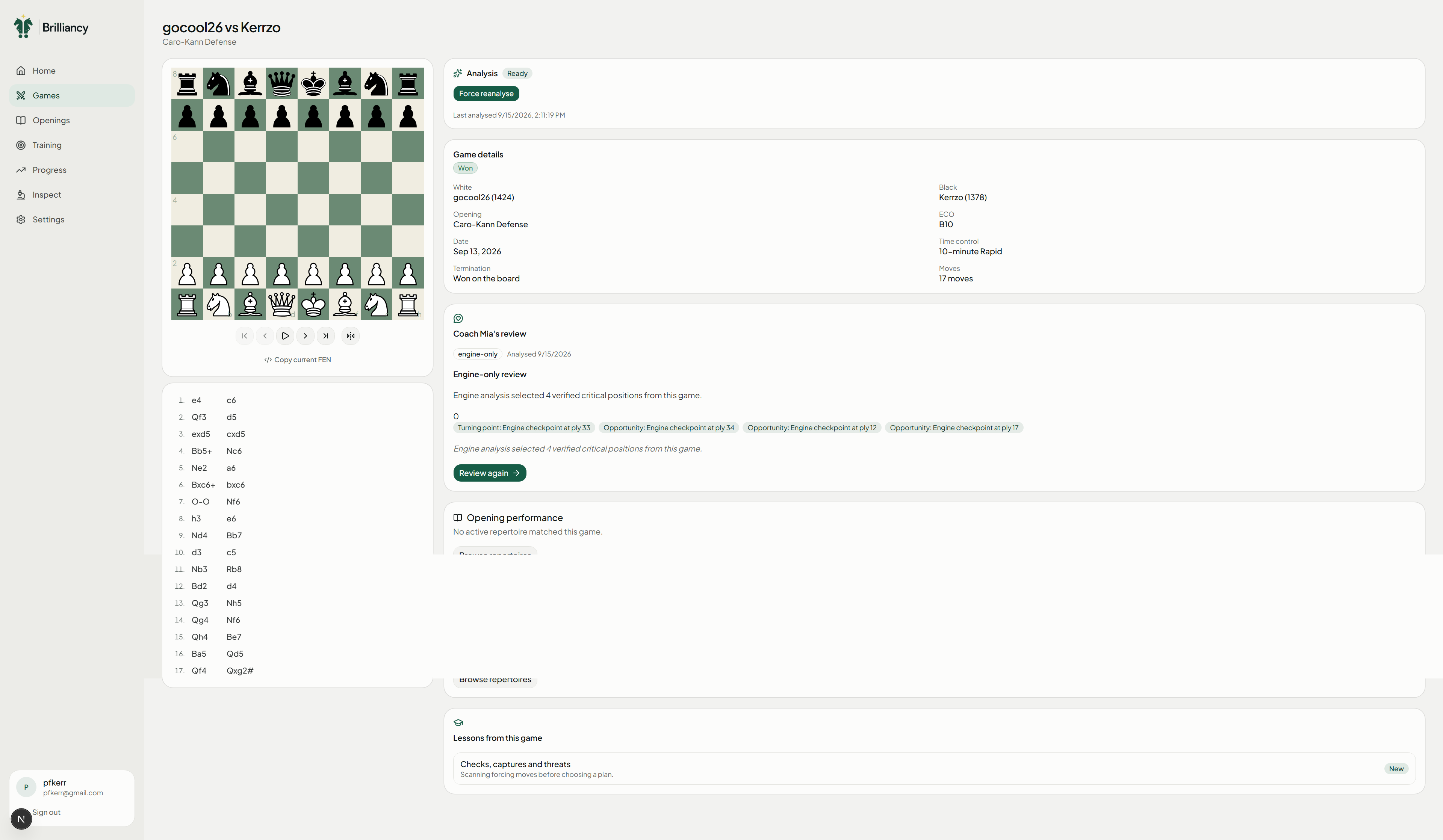
The board, move history and review in one place. This capture shows an engine-only review; the coaching still has to prove its value.
The engine already knows I made a mistake.
Chess software is extraordinarily good at analysing positions.
After a game I can see evaluation changes, inaccuracies, mistakes, blunders, best moves and engine lines.
But knowing that my move was wrong isn't the same as understanding why.
The engine might tell me Nf5?! and show me a stronger move.
What I actually want to know is:
What did I misunderstand about the position?
And perhaps more importantly:
Have I misunderstood this before?
That's the question behind Brilliancy.
An engine finds the move.
A coach explains the idea.
The best training material might already be in my history.
Generic chess lessons are useful.
But my own games contain something much more personal: the positions I actually misunderstand.
I'm exploring how Brilliancy can use game history to look for recurring tactical mistakes, positional misunderstandings, opening problems, missed opportunities and positions worth revisiting.
The idea isn't simply to analyse the last game.
It's to build an understanding of the player over time.
My mistakes become part of the curriculum.
“Best move: Nc7” isn't coaching.
An engine can tell me which move it prefers.
That's useful evidence. But it often isn't the thing I need to learn.
I find myself asking questions like:
- Why is Nc7 useful?
- Why was that pawn push wrong?
- Why did I feel boxed in?
- When should I stop following the opening plan and develop instead?
- What was my opponent actually threatening?
A coach needs to translate engine analysis into something I can use: the idea, the threat, the plan, the trade-off, and what I should notice next time.
The move matters.
The reason is what I need to remember.
A coach should remember what I keep getting wrong.
Most chess analysis effectively starts again with every game.
I don't think a coach should.
If I've misunderstood the same structure three times, that matters.
If I repeatedly delay development, miss the same tactical pattern or mishandle the same kind of endgame, the next review shouldn't treat that as an isolated mistake.
The engine knows the position.
The coach should know the player.
That memory is what turns a collection of game reviews into a coaching system.
- Play
- Review
- Understand
- Remember
- Revisit
- Play
A game shouldn't disappear after analysis. It should become part of what the coach knows about the player.
Finding a mistake once isn't enough.
Remembering a weakness is only useful if the product helps me work on it.
A position from one of my own games can become training material. This is the learning loop I'm working towards.
Later, the coach could bring it back:
What would you play here?
What is your opponent threatening?
What plan would you choose?
The aim isn't to memorise an engine move.
It's to recognise the idea when I see it again.
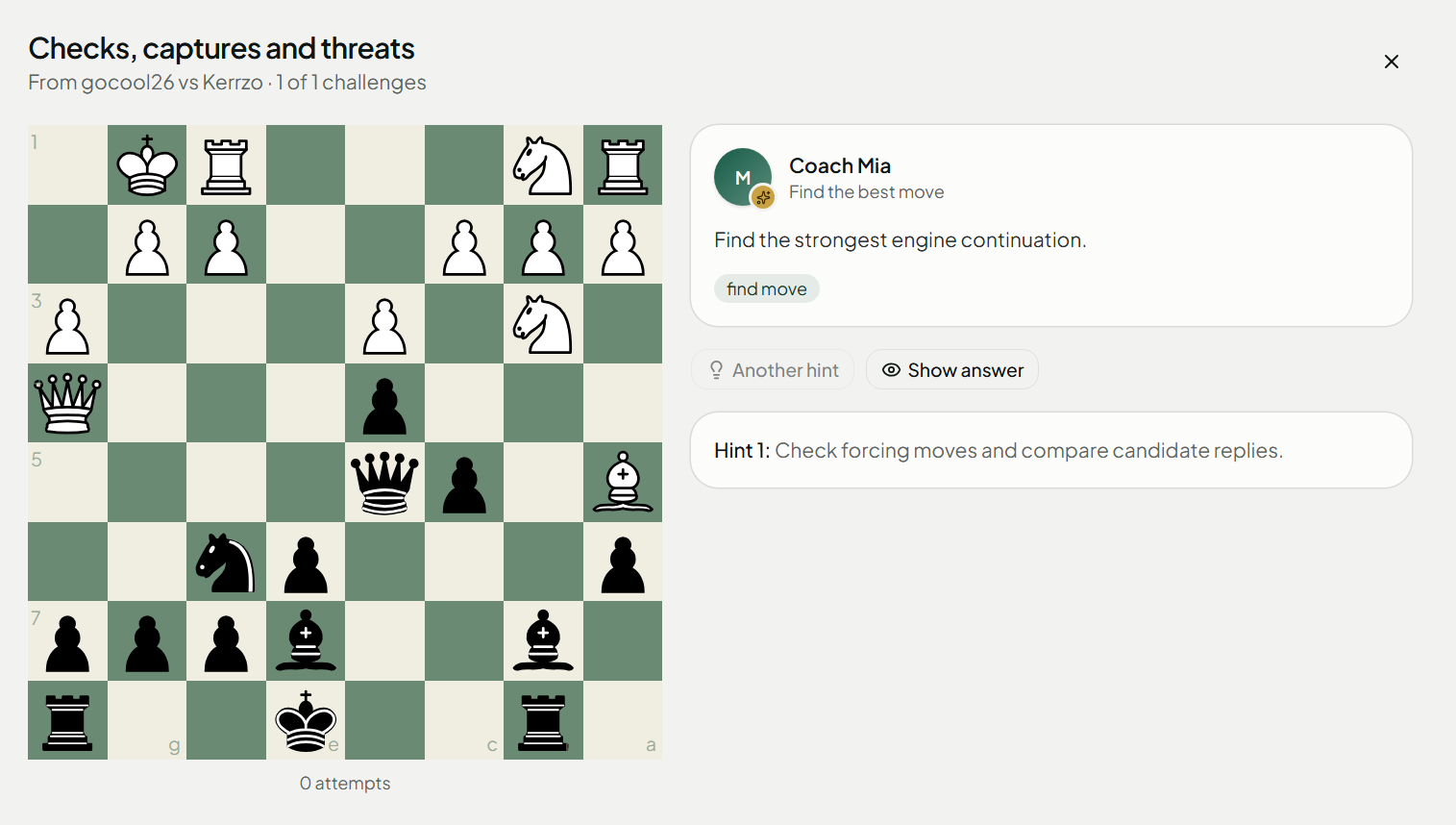
A position from my own game becomes a training challenge. Bringing the right ideas back over time is the learning loop I'm working towards.
Openings are easier when I understand the plan.
I don't want to memorise twenty engine moves.
As an improving player, I want to understand:
Where do my pieces normally belong?
What pawn breaks matter?
What is my opponent trying to achieve?
What mistakes should I recognise?
And when has the position changed enough that the normal opening plan no longer applies?
Opening study becomes more useful when it connects back to the games I've actually played.
If I repeatedly reach the same structure and make the same strategic mistake, that belongs in the coaching system too.
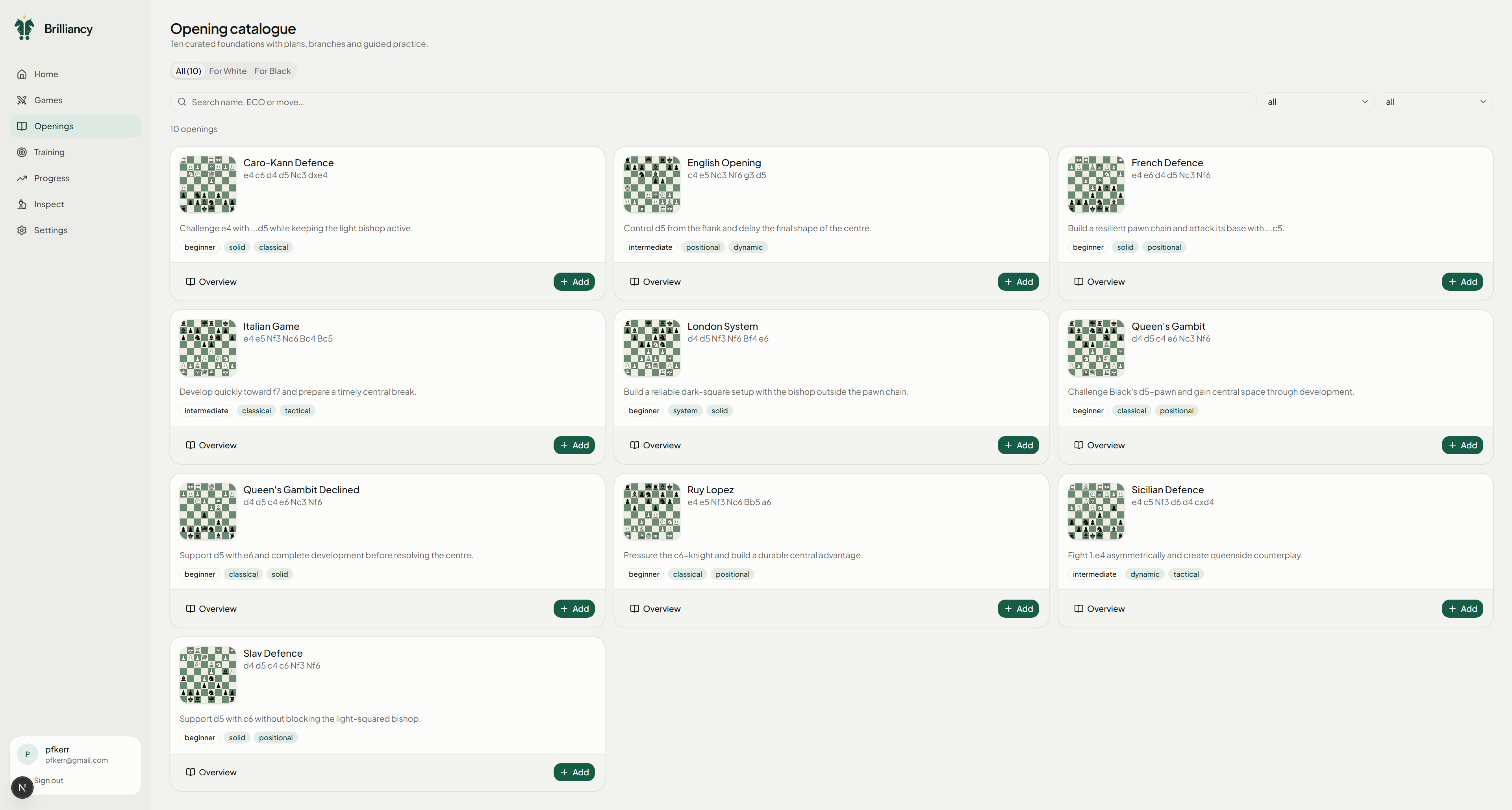
Opening positions alongside the ideas behind them, with a route into repertoire study.
Analysis should feel like a conversation.
A static report can tell me what happened.
A coach should let me ask why.
Why was that move bad?
What did I miss?
What would have happened if I'd played this instead?
Have I made this mistake before?
The longer-term idea is a coach that can walk through a game, answer follow-up questions, challenge a decision and connect the current position to things we've already discussed.
The important part isn't giving the AI a personality.
It's continuity.
A useful coach should know what we've already talked about.
The board is still the centre of the experience.
Brilliancy is still a chess product.
The board, the position and the moves have to remain at the centre of the experience.
AI should make those things easier to understand — not bury them underneath another interface.
The product brings together the board, move history, engine analysis, evaluation, annotations and coaching narrative so I can move between what happened, why it happened, and what I should learn from it.
Moving between the position, the moves and the lessons from a game.
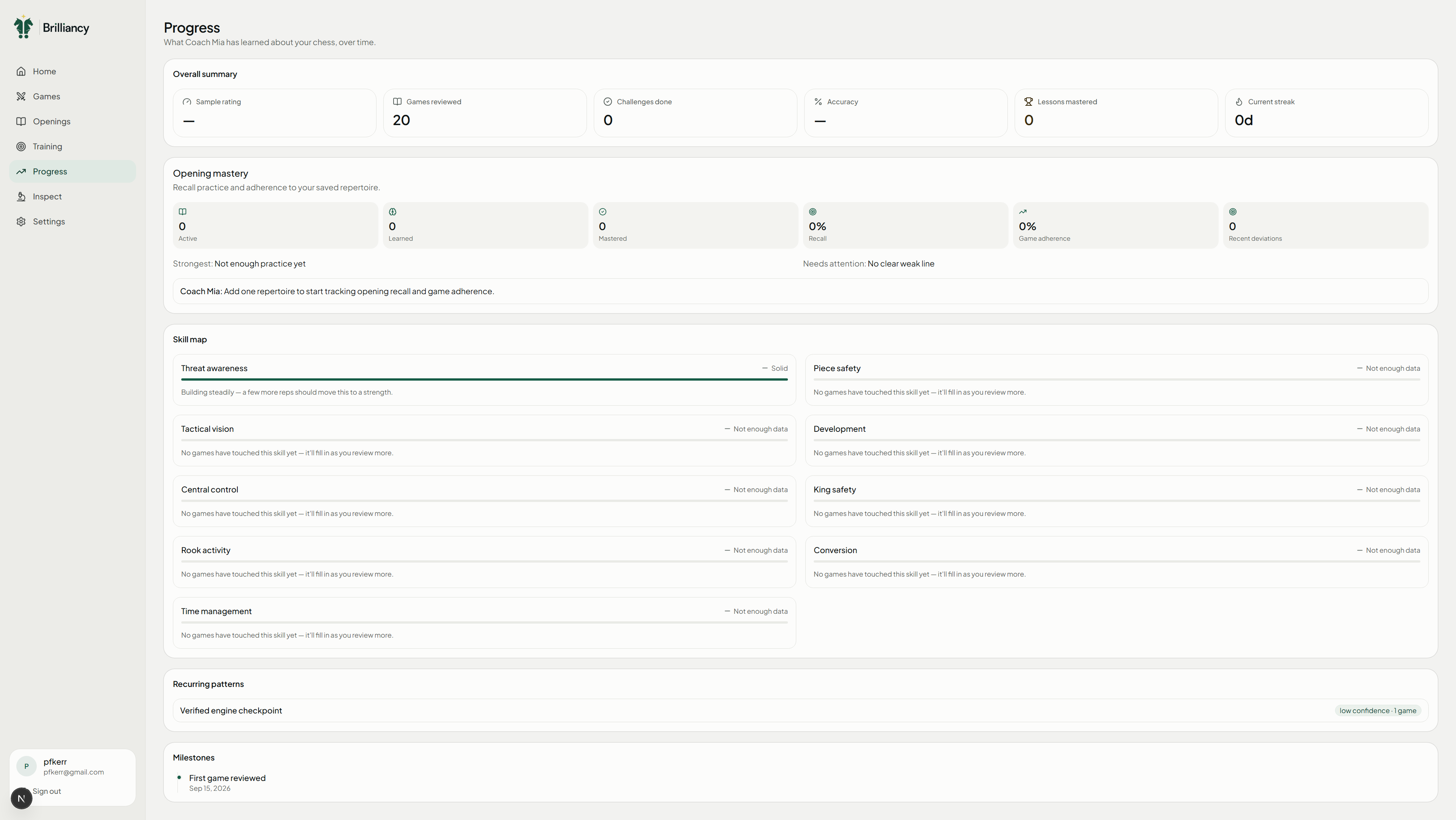
The progress view brings reviewed games, skills and recurring patterns together. It is a view of the learning history, not proof of improved chess.
AI should make the chess
easier to understand.
It shouldn't make the interface more complicated.
Engine truth. AI explanation. Player memory.
Different parts of the system have different jobs.
The chess engine evaluates the position.
Deterministic chess logic handles the game state, legal moves and notation.
AI explains, converses and coaches.
Player history provides the context that makes the coaching personal.
Use deterministic chess tools for chess truth.
Use AI for explanation and coaching.
- Chess engine
- Position evaluation / candidate moves
- Chess logic
- Game state / legal moves / notation
- AI
- Explanation / conversation / coaching
- Player history
- Games / mistakes / repertoire / learning history
The architecture follows the coaching.
The first version explored fully local AI. That remains interesting for privacy, experimentation and control.
The current direction is cloud-first. It offers a simpler product experience and access to stronger hosted models. I want local inference to remain an architectural question, rather than become the reason the product exists.
The question here is whether the coaching helps. The local-versus-cloud trade-offs deserve their own Learning.
The test isn't whether AI can explain a chess move.
It can.
The harder question is whether that explanation changes what happens later.
Do I understand the position better?
Do I remember the idea?
Do I recognise it in another game?
Do I stop repeating the same mistake?
Do I make a better decision next time?
That's what Brilliancy still has to prove.
I'm building the coach I want to use.
I'm using my own games as the first test environment.
That makes it easy to notice when the coaching genuinely helps — and when it's merely producing plausible-sounding chess commentary.
The product will change.
The coaching will change.
Some ideas will survive. Others won't.
But the question I'm trying to answer is simple:
Can software move from analysing my chess to actually helping me learn it?